Julia Carr-Thornton, DPhil, Oxon
Artist & Historian
ORCID iD: 0009-0009-3451-3326
Alexandre Brongniart
Alexandre Brongniart was both the founder of modern ceramic science and a key 19th C geologist and natural historian.
Born in 1770, he was raised in Paris among the artisanal and scientific networks of the city.
His early education began alongside several key Parisian scientific figures, including Antoine Lavoisier, Jean Étienne Guettard, Louis Jean Marie Daubenton, Déodat Gratet de Dolomieu, and many others.
In 1800, Brongniart was nominated to the directorship of the Sèvres Manufactory in Paris.
Brongniart's early work with his close friend Georges Cuvier––famous for his comparative anatomy studies––introduced a key stratigraphical study on the Paris Basin in 1807.
Brongniart's biography tells the story of the transformation of a broadly-focussed French and European Natural History into an interdisciplinary field of sciences such as geology, palaeontology, stratigraphy, mineralogy, and biology.
Most importantly, in the 19th century Brongniart gave a name to the field of Ceramics and created a foundational structure for a new Ceramic Science.


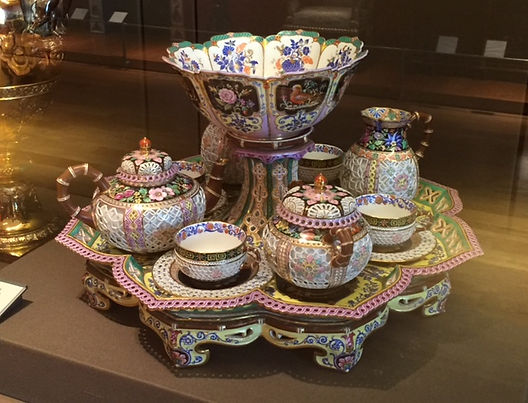

As director of the Sèvres Porcelain Manufactory, Brongniart worked with a wide community of painters, sculptors, architects, artisans, chemists, natural historians, writers, politicians, and other influential members of Parisian society.
Several of my website pages here offer glimpses into the visual culture and stories of this vibrant and interconnected community.

The Tableau des Terrains was a schematic drawing of the Earth's strata. The single sheet illustration depicted Brongniart's mature ideas on the nature and history of the earth, including his views on the expansive, but unknown ages that it took to create the present-day surface of the Earth. The map was accompanied by a lengthy discussion based on several decades of his research.
Brongniart, Exposition Graphique du Tableau des Terrains, 1829
Brongniart, Alexandre. Tableau des terrains qui composent l'écorce du globe: ou, Essai sur la structure de la partie connue de la terre. Belgium: Soc. Belge de Librairie, 1829.

Deep Time, Global Art, and the Beginnings of Art History
My ongoing work reshapes the traditional view that mid-nineteenth-century Art History was wholly Eurocentric or Classical. Mainstream Art Historical discussions frequently focussed on achievements in Egypt, Greece, and Rome and reflected a general agreement that the Earth was formed under a short, 6000-year time scale. While this approach was predominant, I show that Brongniart was the first historian of the fine and applied arts to integrate knowledge of geological time into his thinking and classificatory structures. His outlook was global and integrative from the start. Brongniart's position as a key geological theorist and his unusual understanding of deep time gave him a perspective on human production in the arts that was at least fifty years ahead of mainstream thought. In turn, Brongniart's work directly influenced the ideas and theoretical approach of the art historian and architect Gottfried Semper, who is often seen as the first modern art historian.

I recently completed a doctoral thesis on the life and work of ceramist and natural historian Alexandre Brongniart at the University of Oxford.
You can find the full text here:
Alexandre Brongniart (1770-1847): Kinship, Natural History, and the Invention of Ceramic Science